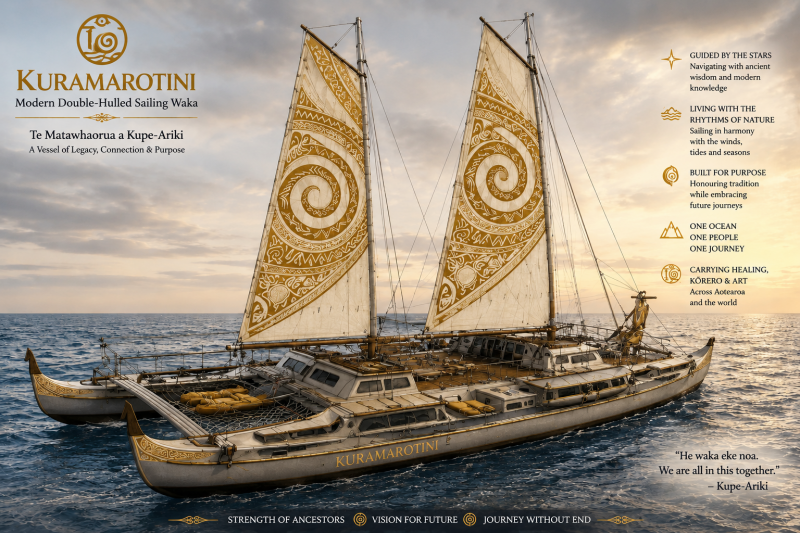
Kuramarotini

Te Matawhaorua a Kupe-Ariki
Te Matawhaorua a Kupe-Ariki is the deep-sea navigation waka of Kupe, held for Te Hokianga Nui Ō Kupe.
It is not a concept, a proposal, or a future aspiration. It is an existing waka whose form is already complete in its parts.
The hulls, cross-beams, cabins, and structural elements are already present.
What remains is not construction in the conventional sense, but the binding together of what already exists.
The final work is the lashing, thatching, and unification of the waka — an act of timing, relationship, and alignment rather than manufacture.
This is a living process, not a mechanical one.
Te Matawhaorua a Kupe-Ariki exists within the infrastructure of Te Tikanga Nui Ō Te Mana Tuku Iho — the Supreme Order of IO Inherent Authority — and is actioned relationally through IO Inherent Relations International (IRI).
Within this living framework, the waka is not treated as an object, asset, or project, but as a living body that must be brought into coherence at the correct time, by the correct people, and under the correct conditions.
There is an interlocking relationship between Te Matawhaorua a Kupe-Ariki and Te Whare Kokorangi Ō Kupe Nuku IO-Ariki, the school of celestial knowledge.
Te Whare Kokorangi holds the navigational, astronomical, and cosmological knowledge that informs the waka’s purpose, orientation, and movement across Te Moana Nui a Kiwa.
The waka and the Whare are not separate functions; they operate together — one carrying knowledge, the other enacting it.
Te Matawhaorua a Kupe-Ariki is not being rushed, announced, or positioned for display.
It stands in readiness.
The waka will be completed when the binding together of its parts aligns with whenua, moana, people, and time.
Until then, it remains held — active, present, and awaiting coherence.
This is not a beginning.
It is not an ending.
It is the gathering together of what is already prepared.
Te Pahi: Tūnui Paia I Te Paora